

What “Availability” Actually Means
Availability is not a mindset or an aspiration. It is a practical state.
It means being able to train when planned, perform when required, and repeat both without interruption. Not occasionally, not optimistically, but consistently over time.
In professional contexts, availability is binary. You are either available or you are not. Partial availability is still a failure if it alters performance, limits preparation, or forces compromises elsewhere in the schedule.
This is why availability cannot be treated as a secondary benefit of “good training.” It is an outcome that must be designed for directly. When it is left to chance, it is usually the first thing lost under pressure.
In environments where schedules are fixed and demands are non-negotiable, the ability to remain physically present and functional becomes the primary performance requirement. Strength, conditioning, and aesthetics only matter insofar as they support that state.
When training decisions are judged by availability rather than short-term markers, priorities change. Load is allocated differently. Progress is paced differently. Interventions happen earlier.
That shift is not conservative. It is deliberate.
“In professional contexts, availability is binary. You are either available, or you are not.”
Injury Prevention Through Intentional Strategic Design
“Injury prevention” can sometimes suggest that the goal of training is to avoid something. It frames the body as fragile and the process as defensive.
In practice, most injuries are not the result of a single poor decision or an isolated exercise. They emerge from accumulated misjudgement: volume added too quickly, intensity layered onto fatigue or poor mechanics, warning signs rationalised away because progress looks good on paper.
Good training does not eliminate stress. It allocates it deliberately. Tissue adapts to load when that load is applied with sufficient context, recovery, and margin. Removing stress entirely does not reduce injury risk; it often increases it by leaving the system underprepared for unavoidable demands.
The problem with the injury-prevention frame is that it encourages avoidance rather than design. It prioritises caution over judgement, and rules over observation. This is how programmes become conservative without becoming safer.
A more useful question is not “How do we prevent injury?” but “What level of stress can this individual tolerate repeatedly, without disruption?” That answer changes over time, and it cannot be reduced to a checklist.
When training is judged by availability rather than absence of injury, decisions become clearer. Stress is still applied. It is simply applied with intent.
“Good training doesn’t remove stress. It allocates it deliberately.”
For an in depth discussion of my approach to film preparation please see this interview with HFE
Availability Is Designed, Not Hoped For
Availability is determined by how training load is managed over time, not by whether any single session looks sensible.
Most breakdowns follow the same pattern. Volume creeps up because sessions are being tolerated. Intensity is layered on because performance appears stable. Fatigue accumulates quietly until something gives. When the problem becomes obvious, the cost is already high.
Designing for availability means interrupting that sequence early.
In practice, this comes down to three things: how often load is increased, how long it is sustained, and how quickly it is reduced when recovery lags. None of these decisions are visible in a programme template. They are made in response to how someone is actually responding week to week.
This is why availability cannot be protected by rules alone. Two people can complete the same work and carry very different residual fatigue. One continues to adapt. The other accumulates debt. Treating them the same because the plan says so is how continuity is lost.
Experienced coaches act before performance drops. They adjust volume before joints become reactive, reduce exposure before sleep deteriorates, and slow progression before compensation patterns appear. These decisions often look conservative in isolation. Over time, they are what allow training to continue uninterrupted.
Availability is not preserved by avoiding stress. It is preserved by managing accumulation.
“Most breakdowns are predictable. They are the result of accumulated load, not sudden failure.”
The Cost of Chasing Short-Term Wins
During filming, the pressure to chase visible results is constant. The schedule is fixed, camera days are immovable, and changes that register on screen are rewarded immediately.
The most common example is physique tightening during production. Training volume is increased to accelerate fat loss or sharpen detail at the same time as recovery capacity is falling. Long days, disrupted sleep, travel, and irregular meals all reduce tolerance. On paper, the training may still look reasonable. In practice, the margin is shrinking.
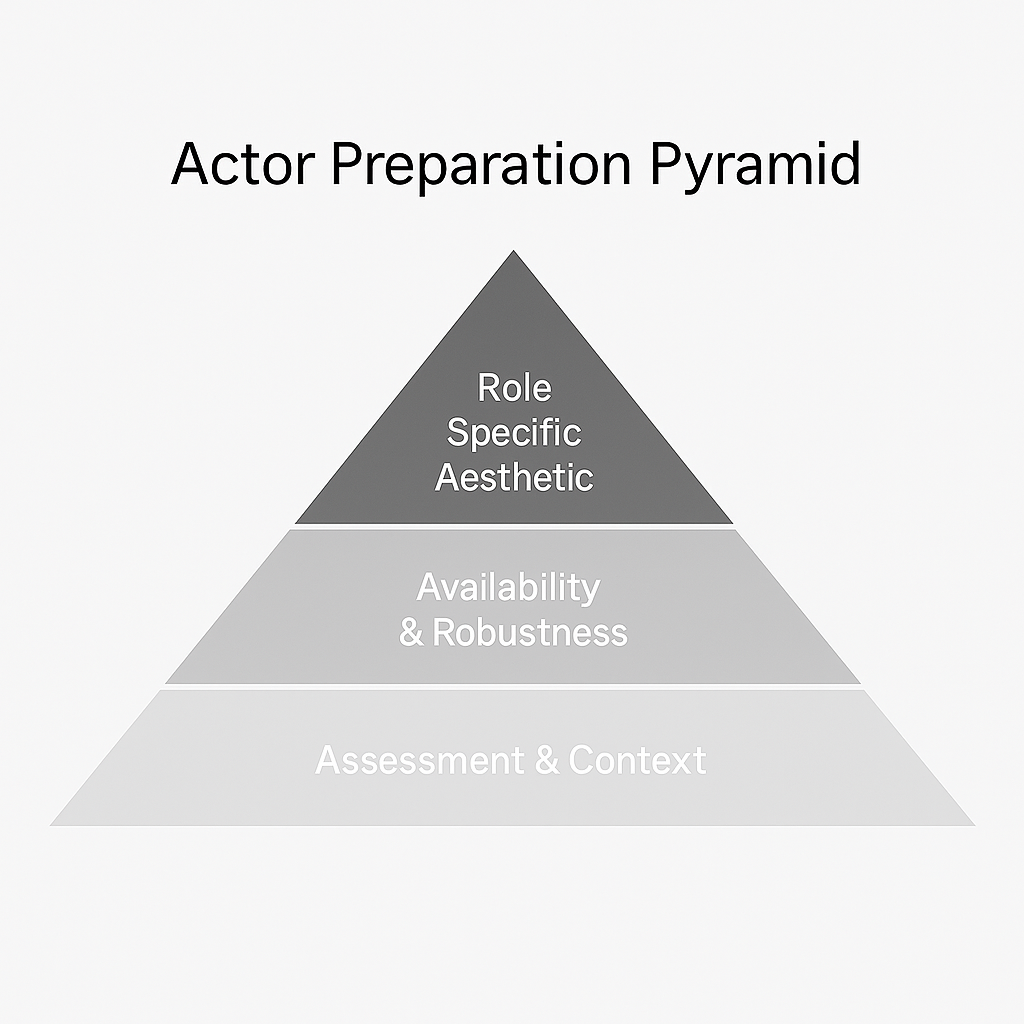
This is where assessment and experience matter. A detailed understanding of biomechanics, anthropometry, and previous injury history allows emerging problems to be anticipated before they surface. When you have taken people through the same preparatory stages repeatedly, patterns become predictable. Fatigue shows up in movement before it shows up in pain. Compensations appear before performance drops. Good coaching is not reactive. It anticipates where pressure will accumulate and adjusts training several stages ahead of that point.
Programme design has to change once filming begins. Load is no longer progressed linearly. Exposure is managed more tightly. The aim shifts from adaptation to maintenance. When programmes fail during production, it is usually because they were not redesigned for the environment they are now operating in.
Coaching judgement connects assessment to execution. Early warning signs are rarely dramatic. Sessions begin to feel heavier. Warm-ups take longer. Small compensations appear under fatigue. Empathy matters here. People under pressure will often minimise these signals because they want to deliver. Observing the pattern, rather than relying on reassurance, is what allows intervention to happen early.
The cost of chasing short-term wins is not limited to physical breakdown. It includes the loss of options when training has to be pulled back abruptly, or when adjustments are made too late to avoid disruption. In a production environment, restraint is not conservative. It is what allows the work to continue until the final day of filming
“Good coaching is not reactive. It anticipates problems several stages before they appear.”
Why Availability Becomes the Primary Metric
In high-constraint environments, availability is the only outcome that matters.
Once schedules are fixed, training is judged by whether it allows continued participation without interruption. Progress is irrelevant if it compromises repeatability. Strength, fitness, and physique changes are secondary to sustained function.
Availability provides a clear test of decision-making. If training repeatedly needs to be reduced, modified, or paused, the system has failed regardless of how productive individual sessions appear. Consistent physical presence indicates that load, recovery, and timing are aligned.
This shift is not conservative. It reflects a change in constraints. When output is non-negotiable, training must prioritise reliability over acceleration.
Availability is not a by-product. It is the result of appropriate assessment, appropriate design, and timely intervention. When those elements are correct, continuity follows.
To learn more about my methods please check out the personal training page
“When continuity matters more than progress, availability becomes the only metric that counts.”
Frequently Asked Questions
Isn’t availability just another word for injury prevention?
No. Injury prevention is part of the strategy. Availability is the outcome.
Someone can avoid a diagnosable injury and still be unavailable if fatigue, pain, or reduced function limits training or performance. Availability captures whether someone can continue to meet the demands placed on them without disruption.
Does prioritising availability mean training more conservatively?
No. It means training with clearer constraints.
In high-demand environments, decisions are judged by whether they preserve continuity. Load is still applied, but it is timed and allocated with greater precision. The goal is not caution; it is precision
Can availability be planned for, or is it only obvious in hindsight?
It can and should be planned for.
Assessment of biomechanics, anthropometry, training history, and recovery behaviour allows predictable pressure points to be identified early. When those patterns are understood, interventions happen upstream rather than in response to breakdown.
Is this approach only relevant for actors and film productions?
No, but it is most visible there.
Any context with fixed schedules, limited recovery, or high consequences for disruption benefits from the same approach. Film production simply makes the cost of poor decisions easier to see.
How do you know when training is starting to compromise availability?
Rarely through one obvious signal.
More often it shows up as slower warm-ups, increasing joint reactivity, declining movement quality under fatigue, or reduced recovery between otherwise familiar sessions. These are indicators of accumulated load, not isolated problems.
Why not just reduce load whenever there’s doubt?
Because removing stress entirely creates a different problem.
Systems that are under-loaded lose tolerance. The objective is not to avoid stress, but to manage accumulation so that exposure remains repeatable over time.
Is availability measurable?
Yes, but not through a single metric.
Consistency of training, stability of performance, recovery between sessions, and absence of forced programme modification over time are all practical indicators. Availability is reflected in continuity, not in test results.
Does this replace goals around strength, fitness, or physique?
No. It governs how those goals are pursued.
When availability is treated as the primary constraint, other goals are sequenced and paced accordingly. They remain relevant, but they are no longer pursued at the expense of continuity.




Leave A Comment
You must be logged in to post a comment.